Organize a shared home with clear rules for rent, bills, groceries, chores, safety and roommate changes
How to Split Rent, Bills and Chores with Roommates
A practical guide to splitting rent, utilities, groceries and chores, tracking repayments and handling a roommate move-out with PartaBill.
See PartaBill in action
Video demonstration
Manage roommate expenses and chores with PartaBill in 45 seconds
Read the transcript
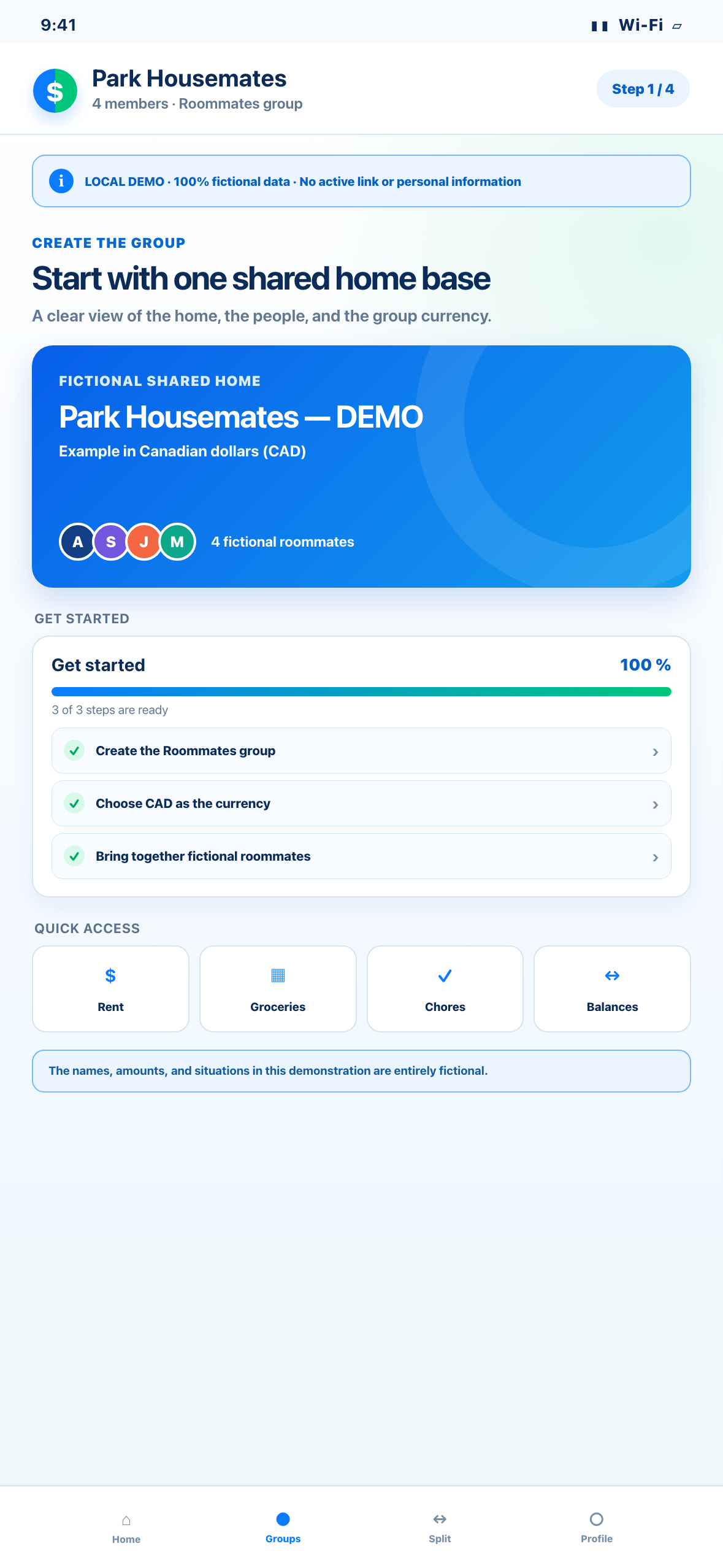
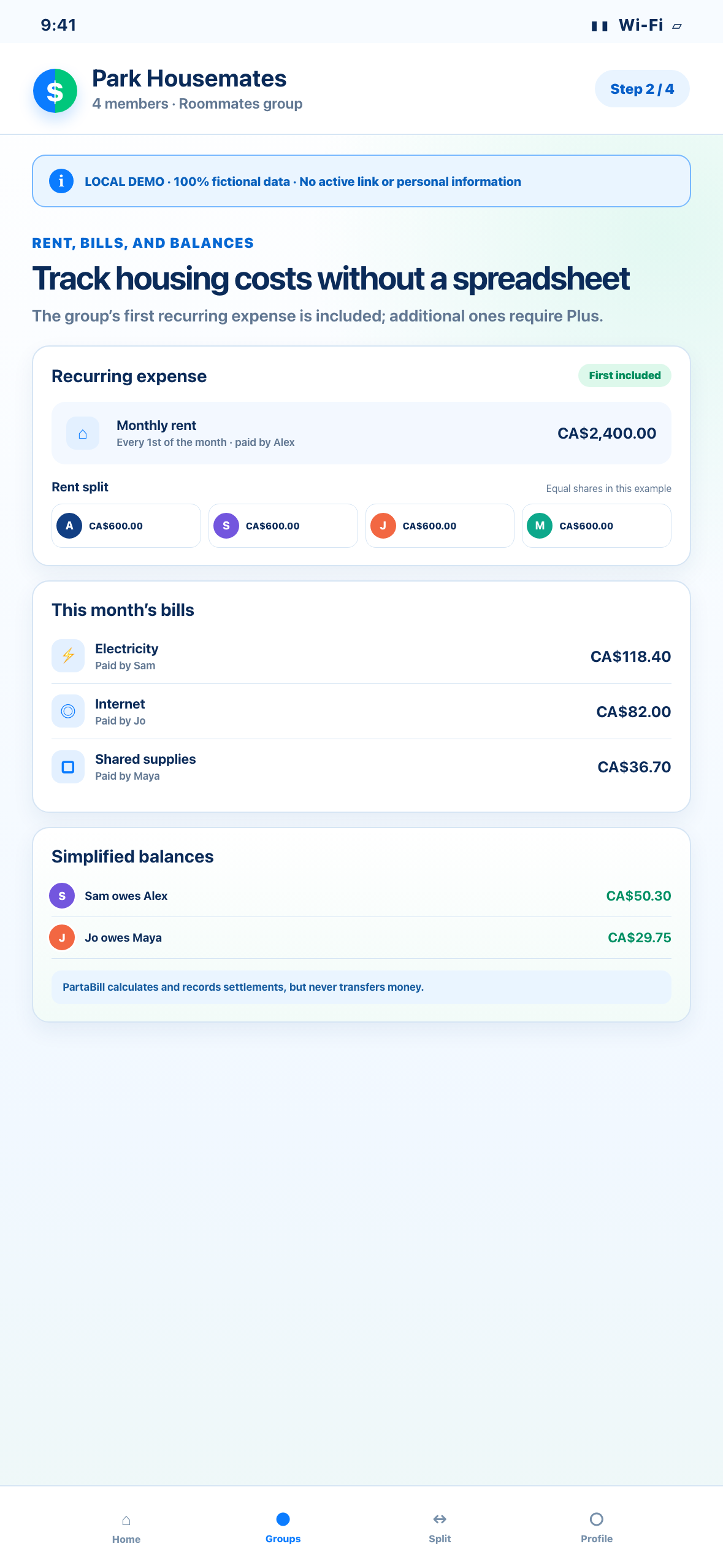
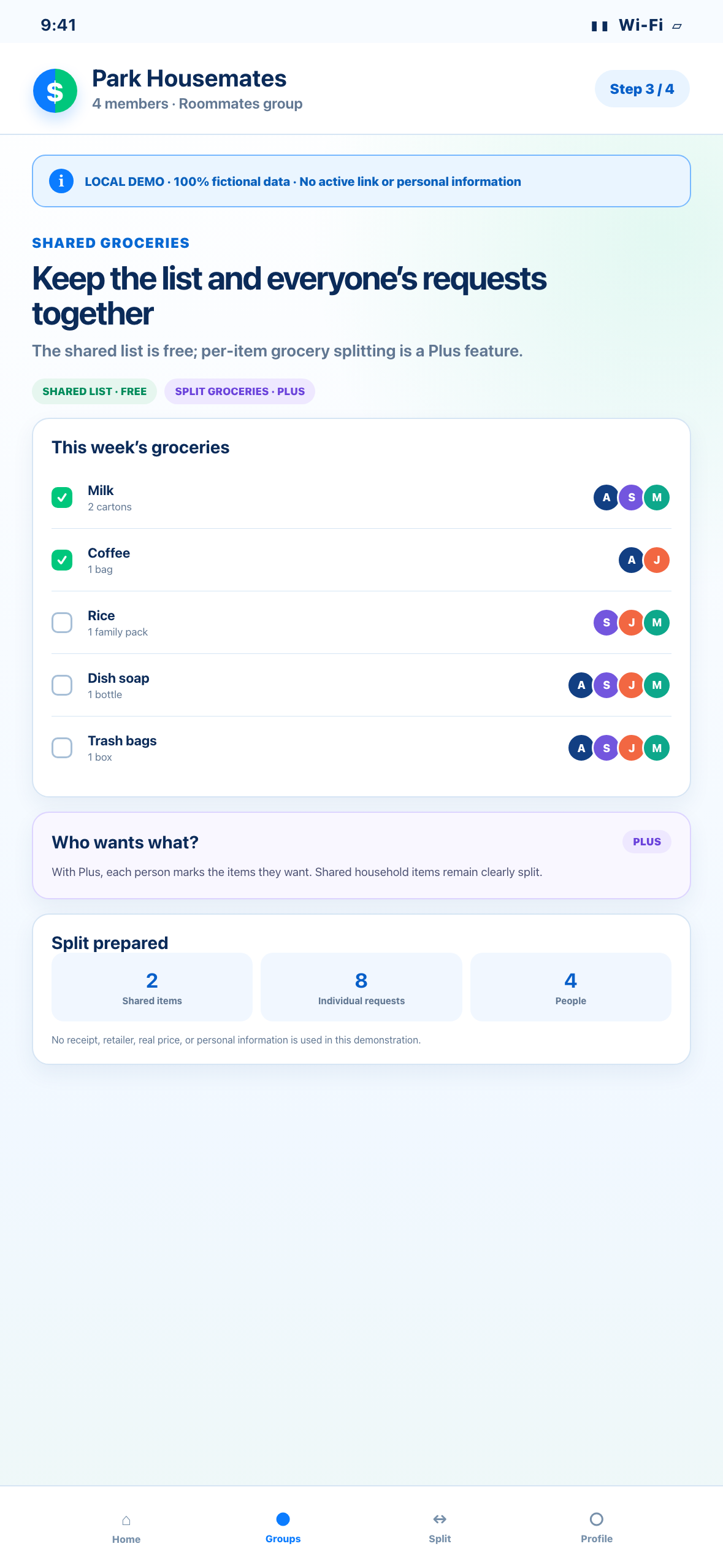
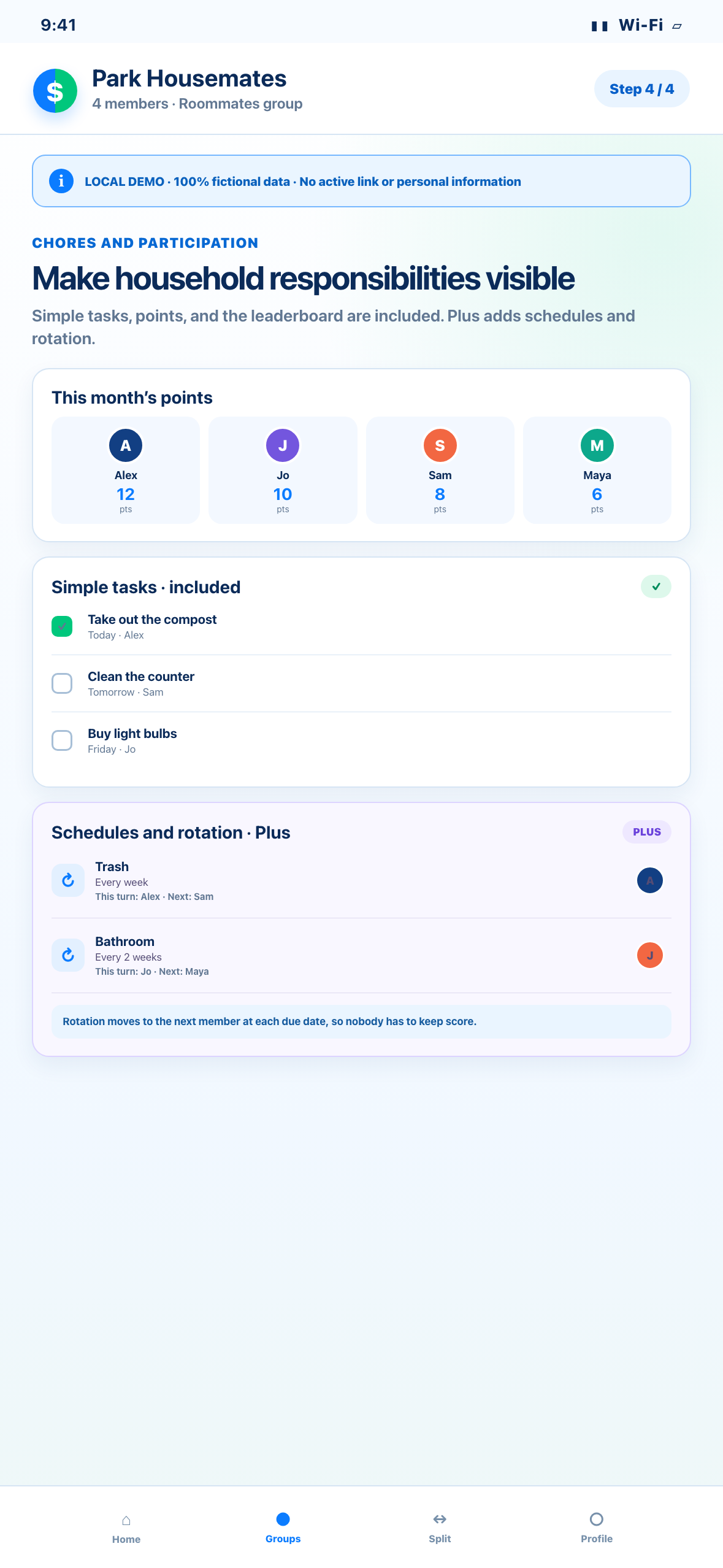
A fictional shared home creates a Roommates group in CAD with four demonstration profiles. It schedules its first recurring rent, adds this month’s bills, and reviews balances without moving money through PartaBill. The roommates then keep a free shared grocery list and use Plus to mark who wants each item. Finally, they track simple tasks, points, and the leaderboard; Plus adds schedules and chore rotation.
Annotated screenshots
The 20-second answer
Before anyone moves in—or before the next bill arrives—write down three things: who is legally connected to the lease, how each household cost will be split and when the roommates will review balances and chores. Separate rent and fixed bills from groceries, occasional purchases and personal items. Keep the agreed rule beside every expense, retain useful proof and settle on a predictable schedule.
PartaBill brings the operational side of a shared home together: a Roommates group, manual expenses, flexible shares, balances, repayments, a monthly group budget, groceries, tasks and conversation. It can reduce arithmetic and forgotten details, but it does not pay rent, move money, enforce a roommate agreement or decide what is legally fair.
The screenshots and 45-second demonstration use four fictional profiles and fictional Canadian-dollar amounts. They explain the workflow; they are not financial, insurance or legal advice.
What is free and what requires Plus?
A Roommates group has no member limit. There is no separate Roommate or “Coloc” plan for sale. Core expense tracking remains available without buying a plan, while advanced functions require Plus according to the limits shown at the point of use in the app. Do not assume that one roommate’s Plus status unlocks every advanced screen for everyone.
| Need | Access verified August 14, 2026 |
|---|---|
| Create a Roommates group, add members and record manual expenses | Free; no roommate member cap |
| Split an expense equally, by shares, percentages or exact amounts | Free |
| See balances, simplify debts and record a repayment | Free |
| Use the monthly group budget | Free; it tracks category caps, not an autonomous forecast |
| Use the basic grocery list, catalogue and built-in templates | Free |
| Split groceries by who wants each item, customize aisles or use grocery favourites | Plus |
| See grocery prices and flyers | Plus; currently limited to supported regions in Quebec and Ontario |
| Create a simple task with an assignee and due date; use points and the leaderboard | Free |
| Schedule recurring chores and rotate them between roommates | Plus |
| Create the first group poll and first recurring expense | Free; later polls or recurrences require Plus |
| Add further configurable lists or upload a new shared document | Plus; authorized members can view accessible documents |
| Use Smart Scan and receipt itemisation | Plus; basic on-device text recognition may be available without Plus |
PartaBill is available on iOS, Android and the Web, but Roommates is not a fully offline workflow. Treat the Web as online. Some cached information or queued actions may survive a brief interruption, but synchronization, invitations, uploads, Smart Scan, grocery prices and manually generating a recurrence need a connection. Taking a receipt photo with the camera is not available on the Web.
The complete twelve-step method
1. Identify each person’s actual housing status
Start with the lease, not the expense app. Determine who signed it, who has a separate lease and who is only an occupant. In Quebec, the Tribunal administratif du logement distinguishes a joint tenant from an occupant and explains that rent liability can be joint or solidary depending on the lease and circumstances. Those terms cannot be copied automatically to another province or country.
Record the practical answer in the household agreement, but consult the actual lease and the local housing authority before acting on a legal issue. A PartaBill profile does not create, remove or transfer tenancy rights.
2. Write a roommate agreement before a disagreement
Use plain language and give every roommate a copy. Cover the rent split, utility bills, exclusive use of bedrooms, shared furniture, insurance, keys, guests, quiet hours, food, chores and the process for leaving or adding someone.
The Quebec tribunal provides an official Agreement between joint tenants covering rent, parking, electricity, heating, Internet, insurance, groceries, household decisions and property. Its own note says that the agreement governs relations between joint tenants but does not change the principal lease or the landlord’s rights and obligations. Elsewhere, use it only as a checklist and adapt it to local law.
3. Map every household cost
Create four groups of costs:
- fixed: rent, parking and Internet;
- variable: electricity, heating and groceries;
- occasional: cleaning supplies, a shared appliance or a repair agreed by the household;
- personal: anything bought for one person only.
The Financial Consumer Agency of Canada recommends considering more than rent and discussing financial responsibilities before moving in. Decide who receives each bill, when its amount becomes known and what proof should be kept. Do not turn a roommate’s personal purchase into a group debt simply because it was bought at the same store.
4. Choose the split expense by expense
Equal shares are simple, but they are not the only defensible method. A larger bedroom or private parking space may justify agreed percentages. Groceries can follow the people who wanted each item. A one-off purchase can use exact amounts. Pick a rule that everyone can understand and reproduce.
PartaBill supports equal shares, shares, percentages and exact amounts for manual expenses. Save the rule with the expense and review it before finalizing. Never change a past split silently; explain the correction so the balance remains understandable.
5. Create the Roommates group carefully
Add the people who really share household expenses. A person without an account can be represented so their balance remains visible and can later be connected to them. Use a recognizable household name and the currency in which most bills are paid.
Set default shares when the same people usually split expenses the same way, but still inspect each new charge. Guests, partners and temporary occupants may not belong on every bill. Keep access to finances, conversation and documents limited to people who need it.
6. Enter rent, utilities and subscriptions
For every recurring bill, record the payee, amount or expected amount, due date, actual payer and split. The first recurring group expense is free; creating more requires Plus. Available frequencies are weekly, monthly and annual.
A critical detail: generated recurring expenses use equal shares among eligible members. They do not reuse the group’s default split. If rent is 60/40 or a subscription excludes one roommate, review and correct the generated expense before relying on the balance. A recurrence is a bookkeeping entry, not a bank withdrawal or a guarantee that the supplier was paid.
7. Separate shared groceries from personal items
Keep the basic household list for food and supplies everyone agreed to share. The free list includes the catalogue and built-in templates. If someone wants a particular item, mark that before shopping instead of negotiating after the receipt arrives.
With Plus, Split groceries prepares the expense according to who wanted each item; custom aisles and grocery favourites are also Plus. Prices and flyers cover supported locations in Quebec and Ontario, not every Canadian or international store. Estimates can change and never replace the shelf price or final receipt.
When using Smart Scan or itemisation, verify every line, tax and total. OCR can make mistakes. Attach or retain proof only when it is useful and appropriate for the group.
8. Review the household budget and settle regularly
Use the monthly group budget to set category caps for rent, utilities, groceries and household supplies, then compare them with recorded spending. A cap is a planning signal, not money reserved in an account and not an automatic forecast. The Canadian budgeting guidance recommends keeping bills and receipts, comparing the plan with actual expenses and adjusting when costs change.
Choose a weekly or monthly settlement date. In Canada, PartaBill can prepare the correct contact detail and amount for an Interac e-Transfer, but the roommate completes the transfer in their banking app. The repayment remains pending until the person paid confirms it. PartaBill does not move or verify the money.
9. Make chores and decisions visible
Write tasks so completion is observable: “take recycling out Wednesday evening” is better than “help more.” Simple tasks can have an assignee and due date, and the group can use points and a monthly leaderboard without Plus.
Plus adds schedules and chore rotation. Rotation is useful for dishes, bathroom cleaning or bins, but it should reflect availability and accessibility rather than treating points as proof of equal effort. Use the group conversation or a poll for changes; the first poll is free and later polls require Plus.
10. Protect personal and financial information
Each roommate should use their own account. The Office of the Privacy Commissioner recommends unique passwords and multi-factor authentication; the Financial Consumer Agency says never to share a banking password, PIN or security answer, even with family. PartaBill never needs a roommate’s online-banking credentials.
Collect only what the household needs. The Quebec tribunal’s privacy guidance concerns rental applications, but its necessity principle is a useful warning against casually copying identification. Do not store a passport, banking screenshot, medical detail or full credit report in a shared group merely for convenience.
11. Confirm insurance and an emergency plan
Do not assume one person’s policy covers unrelated roommates. The Canadian financial agency says people sharing a home should inform their insurer and confirm who the policy covers. Ask the insurer about belongings, personal liability and any requirement in the lease; coverage depends on the actual policy.
Every occupant should know the exits and outdoor meeting point. The Government of Canada recommends identifying safe exits from the home and neighbourhood, anyone who may need help and the location of fire extinguishers, then sharing and practising the plan with the household. Follow municipal rules and the building’s instructions.
12. Close the loop when a roommate leaves
Agree on a date, check the lease and local notice rules, enter all final bills and wait for credits or refunds that have not arrived. Review the balance together before recording the final repayment. Update utility accounts and insurance, return keys, remove access to shared documents and household services, and change passwords that were legitimately shared, such as Wi-Fi access.
Preserve the expense history needed to keep the remaining balances coherent. Removing an account or profile should not be presented as cancelling a lease, releasing a debt or deleting another person’s records.
The 45-second demonstration
The video starts only when selected and is silent by default, with captions and the transcript provided on the page. It shows a fictional four-person household creating a Roommates group, recording rent and current bills, reviewing balances, preparing a grocery split and making chores visible. The final screen distinguishes free tasks and points from Plus schedules and rotation.
The images are local phone-sized Web demonstrations. They do not use a real lease, receipt, address, transfer account or personal information.
Frequently asked questions
Should roommates split rent equally?
Not necessarily. Equal shares are simple; percentages or exact amounts may better reflect a larger bedroom, parking or another agreed benefit. Put the chosen rule in writing and do not present it as a legal requirement.
Does every roommate need to sign the lease?
There is no universal answer. A signatory and an occupant may have different rights and obligations. Read the actual lease and consult the housing authority for the property’s jurisdiction.
What if a utility bill is in one roommate’s name?
The Canada Mortgage and Housing Corporation warns that the named account holder remains responsible to the provider for late or missing payments. Track shares and dates, but do not mistake the internal split for the provider’s contract.
Can PartaBill pay rent or send a reimbursement?
No. It calculates balances, prepares useful payment information and records confirmations. The real payment happens outside PartaBill.
How should groceries be split?
Share true household staples according to the agreed rule and assign personal items to the person who wanted them. With Plus, Split groceries can prepare item ownership, but everyone should review the resulting expense.
What happens if someone pays late?
Raise it early, check the written agreement and correct any mistaken expense first. PartaBill shows the balance; it is not a collection service and cannot determine a legal remedy.
Does one roommate’s insurance cover everyone?
Never assume so. Inform the insurer that the home is shared and ask who and what the actual policy covers.
Can Roommates be used offline?
Not as a complete offline system. Some cached or queued actions may remain available briefly, but synchronization, invitations, uploads, Smart Scan, price data and recurrence generation require a connection.
Does this method apply outside Quebec or Canada?
The organizational method does. The legal, insurance, fire-safety and payment examples do not automatically apply elsewhere; replace them with guidance from the appropriate local authorities.
Try it with your shared home
Create a Roommates group in PartaBill, add rent, electricity and Internet, write down the split for each one and choose the first household task. Start with the free core, then consider Plus only for an advanced function you actually need.
Create our Roommates group · See all Roommates features
Related: split a restaurant receipt item by item · bring your real group share into a personal budget

About the author
Denis Turbide
creator of PartaBill
Revision history
- — Initial publication
Sources and verification
- PartaBill — roommate expense tracker Facts verified: August 14, 2026
- PartaBill — complete feature catalogue Facts verified: August 14, 2026
- PartaBill — support centre Facts verified: August 14, 2026
- PartaBill — terms and current Plus offer Facts verified: August 14, 2026
- Tribunal administratif du logement — joint tenancy in Quebec Facts verified: August 14, 2026
- Tribunal administratif du logement — agreement between joint tenants Facts verified: August 14, 2026
- Tribunal administratif du logement — leases and protection of personal information Facts verified: August 14, 2026
- Financial Consumer Agency of Canada — renting your first apartment or house Facts verified: August 14, 2026
- Financial Consumer Agency of Canada — making a budget Facts verified: August 14, 2026
- Canada Mortgage and Housing Corporation — roommates and pets Facts verified: August 14, 2026
- Financial Consumer Agency of Canada — home and tenant insurance Facts verified: August 14, 2026
- Financial Consumer Agency of Canada — online banking safety Facts verified: August 14, 2026
- Office of the Privacy Commissioner of Canada — protecting accounts with passwords Facts verified: August 14, 2026
- Government of Canada — make a household emergency plan Facts verified: August 14, 2026
Try PartaBill with your own group
Create a group, add an expense, and see what PartaBill can simplify for you.